One of my biggest regrets in life is not taking up an instrument. Actually, that’s not entirely true. Back in fourth grade, a musician came to our class to show us all the cool instruments we could choose. I ended up going with the flute, but honestly, I probably should have picked the clarinet, sax, or drums. Perhaps I’d still be playing.
I assumed the flute was played like a piccolo. When I arrived to my first lesson on campus I quickly learned two things: first, that the instrument was held differently than I thought. Second, I was the only boy in the room; about eight girls and me.
For months I maintained that I chose the flute because of the girls; the truth is, I made a mistake. In another setting I may have enjoyed being with so many girls, but in this case, the ratio was uncomfortable.
What made things worse is that my dad decided that a used instrument was better than spending hundreds of dollars on a brand new one. Subsequently, I arrived with an old, tattered case, and a used flute. Everyone else had shiny new instruments, and pristine cases. Of course, I shouldn’t have been embarrassed about that. In fact, I should have appreciated all the beautiful music my instrument had already played. Sadly, I begged my dad to replace it with a new one. He acquiesced.
I don’t know how long I stayed committed to the flute, but I think it amounted to three months, give or take.
At about the same time, my older brother started playing the trumpet. And one of the first songs he learned to play was Chuck Mangione’s “Feels So Good.” As bad as he played, there was something about the song that sucked me in. And, as he got better, my affinity for the song grew.
Eventually, he started playing Bill Conti’s “Fanfare For Rocky,” from the motion picture, Rocky. As much as I love Conti’s music, I was firmly stuck on Mangione’s “Feels So Good,” and I’d often ask him to play it.
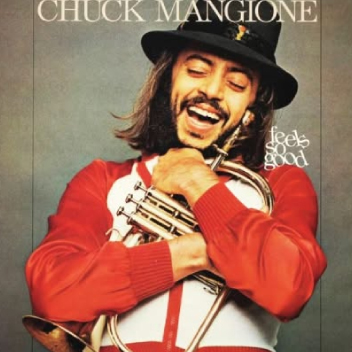
During the latter part of that year, my mom came home with the album you see pictured here. And, for the first time, I heard the real version, by a real musician, and it moved me to the marrow. (Two other songs have done the same: Switch’s “I Call Your Name,” and Luther Vandross’s “Superstar.”) I also could not take my eyes off of the cover. Seeing Mangione hug his flugelhorn with that huge smile warmed my heart.
Years ago one of my dad’s good friends, a jazz aficionado, said this to me: “[John] Coltrane makes me sweat! Once an artist does that to you, never let it go.”
Back in 2018, I downloaded “Feels So Good” on Spotify. And the same feelings all came back. I wasn’t sweating, but the music put me in such a good mood that I played it every morning on my drive in to work.
About an hour ago, a friend of mine texted me with the news that Mangione had passed. Moments later, as I scrolled through social media, the news began to hit my feed. He was 84.
Mangione received 14 Grammy nominations, winning twice: in 1976 for Best Instrumental Composition for “Bellavia,” and again in 1979 for Best Pop Instrumental Performance for the title track of a film score for “The Children of Sanchez.”
“Feels So Good” was a huge hit, and was even nominated for Record of the Year (1979). Ultimately, the award went to Billy Joel for “Just the Way You Are.”
The opening to “Feels So Good” is beautifully melancholic. In fact, when I played it for students, many of them thought it was sad. But once the electric piano and guitar kick in, the mood changes.
I have mixed feelings today. I am sad Mangione is gone, but happy that his music and legacy live on.
And what more can one ask for?


Leave a Reply